A multi-day trip is decided with day four in mind
A one-day ride is judged by how you feel at the end. A multi-day trip is judged by how you start the morning of the fourth day, when your legs already have kilometers in them and the group is still the same. That’s why it’s worth choosing the bike for the whole week and not for the first climb.
At Seekers we rent both options, standard MTB and E-Bike, and adapt them to what each participant needs. This post helps you arrive at that conversation with clearer ideas.
What changes with each bike
General reference. The actual experience depends on the bike model, the terrain and the assist level.
Is the battery enough?
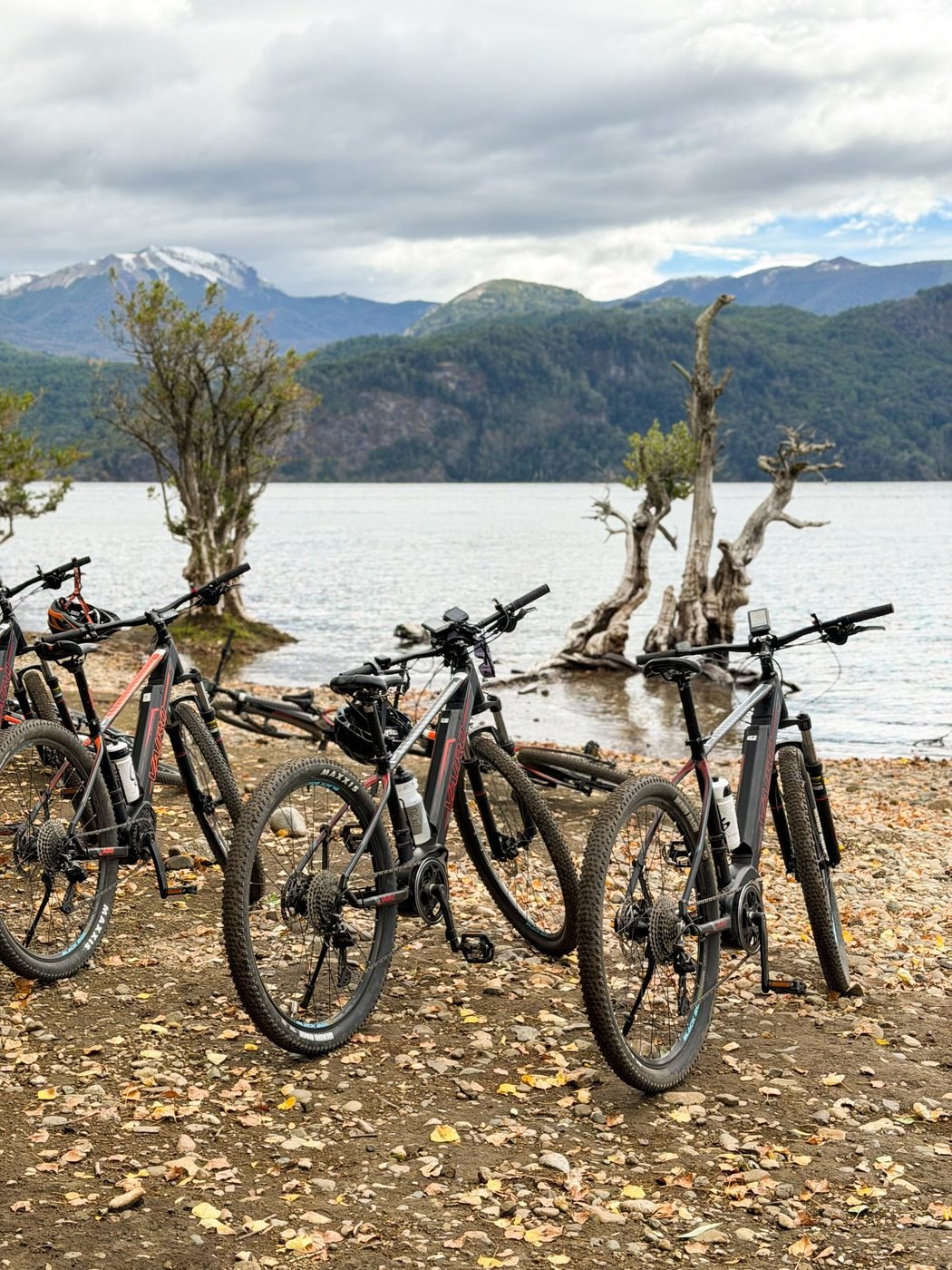
One practical question remains about the E-Bike: is the battery enough? Gabriel Ortega, a Seekers guide, answers it with figures from our own bikes. With assistance at level 1 on flat ground, the battery gives a safe 100 kilometers. On the routes we ride, covering 50 to 60 kilometers, we always finish with 25 to 30% of battery left.
We always charge the batteries the day before and, during the ride, if we stop at a restaurant or somewhere else, we take the chance to charge them. On certain routes we bring an electric generator; on the rest, everything is planned so it is not needed.
These are figures from our bikes, not for any E-Bike: real range depends on the assist level, the climbing and the weight, which is why charging is planned route by route.
How is E-Bike battery charging managed?
Gabriel Ortega, Seekers guide. The batteries are always charged the day before, and again at every stop. Video in Spanish, with Spanish subtitles.
What physiology says
A 2019 pilot study from Brigham Young University compared 33 experienced mountain bikers on the same short loop, once on a standard mountain bike and once on an E-Bike with pedal assist. On the E-Bike, average heart rate was about 10 beats per minute lower (145 versus 155). Even so, almost everyone stayed at a vigorous intensity: 29 of 33 on the E-Bike and 31 of 33 on the standard bike. They also finished the loop about twelve minutes faster.
Read carefully: the E-Bike reduces effort without removing it, and on that loop it was faster. The study had few participants, a single lap, one bike model and a group that already had experience, so it works as a clue and not as a rule for everyone.
What happens in your head
The effort you feel doesn’t always match what a heart rate monitor shows. A 2022 review of perceived exertion explains that this sensation is generated mostly from the command the brain sends to move the muscles and breathe, and that it isn’t a direct reading of the load your body is under. Two people with the same heart rate can experience the same stretch very differently. That’s why how you feel counts as much as the numbers.
Ryan and Deci’s self-determination theory proposes three needs that sustain motivation: feeling that you choose (autonomy), feeling that you can (competence) and feeling part of a group (relatedness). Applied to this decision, and this is our reading, not the authors’: choose the bike yourself, choose one that lets you feel capable on day four too, and think about which one lets you share the pace with the people you’re traveling with.
Csikszentmihalyi’s flow theory adds a useful question. According to that theory, we enjoy an activity more when challenge and skill are evenly matched: if the route overwhelms you, anxiety appears, and if it falls short, boredom does. It’s a theory, not a recipe. It helps put the decision another way: on which bike does the challenge sit at a point where you still have attention left to look at the landscape?
Five questions to decide
When each one tends to fit
Standard MTB
E-Bike
What each one costs to rent
These are the values published on each trip page. They can change: confirm them on the trip page or on WhatsApp. Vergara-Pehuenche also has E-Bikes for rent: ask us for the options and the price.
How we handle it at Seekers
We rent both and adapt them to what each participant needs. Tell us how many days in a row you’ve ridden, what experience you have and what worries you, and we’ll work it out together before departure. On every trip you can bring your own bike; renting is one more option.
Once on the road, each day’s guide accompanies the group’s pace and keeps an eye on how each person is feeling.
- Hall C. et al. (2019). Pedal-Assist Mountain Bikes: A Pilot Study Comparison of the Exercise Response, Perceptions, and Beliefs of Experienced Mountain Bikers. JMIR Formative Research
- Lopes T. R., Pereira H. M. and Silva B. M. (2022). Perceived Exertion: Revisiting the History and Updating the Neurophysiology and the Practical Applications. International Journal of Environmental Research and Public Health
- Ryan R. M. and Deci E. L. (2000). Self-determination theory and the facilitation of intrinsic motivation, social development, and well-being. American Psychologist